The LIGO–Virgo–KAGRA (LVK) detector network comprises three centers across the globe. The United States hosts twin Laser Interferometer Gravitational-Wave Observatory (LIGO) detectors, one located at Hanford Observatory in Washington State and a second at Livingston Observatory in Louisiana. The Virgo detector is hosted by the European Gravitational Observatory in Italy, and the Kamioka Gravitational Wave (KAGRA) detector is hosted in Japan by the Institute for Cosmic Ray Research (ICRR) of the University of Tokyo.
Researchers at Georgia Tech play a key role in the international collaboration. The Georgia Tech-LIGO research group includes School of Physics Professor Laura Cadonati, Assistant Professor Surabhi Sachdev, Research Scientist Margaret Millhouse, Postdoctoral Scholar Prathamesh Joshi, eight graduate students, and multiple undergraduates.
The LVK network detects gravitational waves when a massive cosmic event — like the collision of two black holes — creates invisible ripples in the fabric of space-time. Waves ripple out at the speed of light, and millions of years after the events that first created them, they reach the LVK detectors.
But detecting gravitational waves does not simply mean capturing a signal — clues first need to be untangled from background noise.
“Identifying gravitational-wave signals requires carefully separating real astrophysical events from random fluctuations in the data,” says School of Physics graduate student Urja Shah, whose work to quickly identify phenomena supports rapid follow-up by the broader astronomical community.
To support the identification of phenomena, School of Physics graduate student Megan Arogeti conducts consistency tests between waveforms, checking results to find unexpected or unusual features. “Tests like this give us confidence in our models as we continue to observe gravitational waves with increasing sensitivity,” she explains. “They support new observations and help identify exciting new physics.”
“These efforts help ensure that gravitational-wave signals are robustly identified and accurately characterized, turning each detection into a precise measurement,” adds Shah. “In turn, these measurements deepen our understanding of some of the most massive and dense objects in the universe and the fundamental laws governing the cosmos.”
Astrocalibration Autotune
When a sensor detects a gravitational wave, it produces a distinctive response, says School of Physics graduate student Shobhit Ranjan. “Those signals encode a wealth of information we can analyze to learn about their sources — their masses, spins, distance, and location.” But in order to detect these chirps, the detectors must be carefully calibrated, and if calibration is not optimal, the signals can be compromised.
Now, a new tool is helping the LVK collaboration recalibrate less optimal signals. The technique is already showing promise: In an article recently accepted in Physical Review Letters, LVK researchers successfully applied it to two interesting signals. The first signal served as a testing opportunity for the method. The team used astrocalibration to recover the data and check it against secondary independent calibration data that was available. They then put the technique to use, recovering information from a second event where no secondary calibration data were available.
“Like autotune in the music industry, the new research shows that theoretical models can be used as guides, similar to how sheet music can help a studio shift off-key music to its correct tone,” Ranjan explains. “These theoretical models suggest the shape of the signal, and together with data from other detectors, we can adjust the data and read it correctly.”
“The fact that these detectors can now not only sense cosmic events, but leverage them to improve the data being collected marks a new era in gravitational wave science,” he adds.
A Record-Setting Dataset
The LVK Collaboration also published their fifth catalog of gravitational wave events this spring. The findings include an updated estimate of how fast the universe is expanding, evidence for the existence of second-generation black holes, the most precise sky localization ever achieved for a gravitational wave source, and the first measurement of three vibrational modes of a black hole.
“Our group helped enable 140 detections out of the 161 reported in this catalog,” says Joshi, who contributed to one of the flagship searches and designed a specialized search focused on detecting especially heavy black hole mergers.
Joshi also worked on determining precise locations of where the gravitational waves originated from in the universe — research that he says will allow astronomers around the world to perform long-term follow-up observations of interesting events.
One record-setting detection showed two black holes that had violently collided more than 3 billion light-years from Earth. Researchers were able to pinpoint its location in the sky more precisely than any other gravitational wave event observed before.
Improvements in the LVK network’s ability to localize events along with the large number of detections allowed for a better estimate of the Hubble constant, which measures the rate at which the universe is expanding. The new measurement is over 25% more precise than previous estimates.
The new catalog also includes the “clearest” gravitational wave signal ever detected. The clarity of the signal led to the most accurate test of general relativity ever performed and confirmation of Stephen Hawking’s black hole area theorem.
“This catalog provides not just the largest number of black hole detections, it marks a new era of rapid progress,” Sachdev says. “This is just the beginning of what these observations will allow us to uncover.”
Related Media
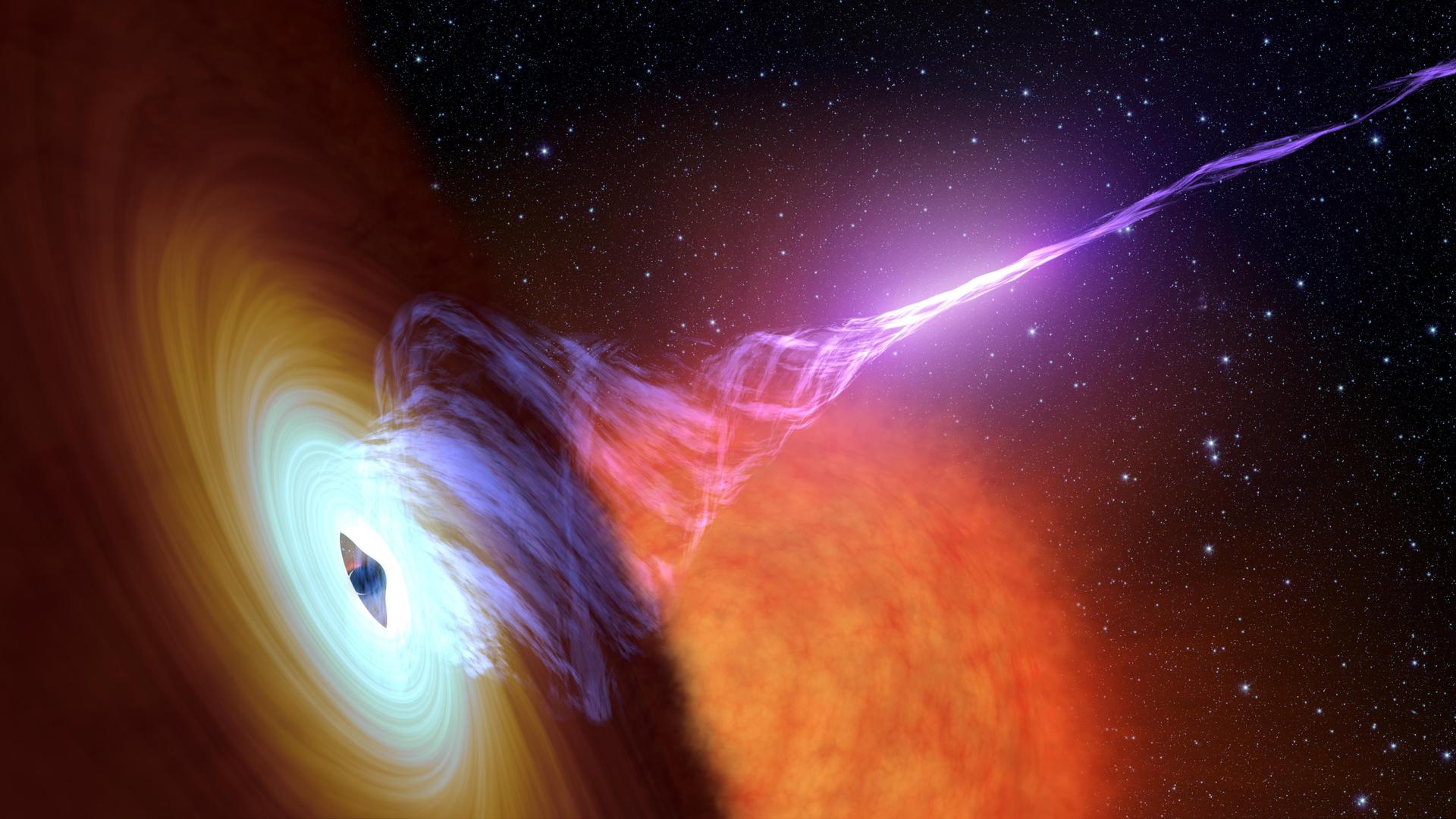
An artist's concept showing a black hole. (Credit: NASA/JPL)
For More Information Contact
Selena Langner
Technical Research Writer / Editor
Georgia Tech College of Sciences