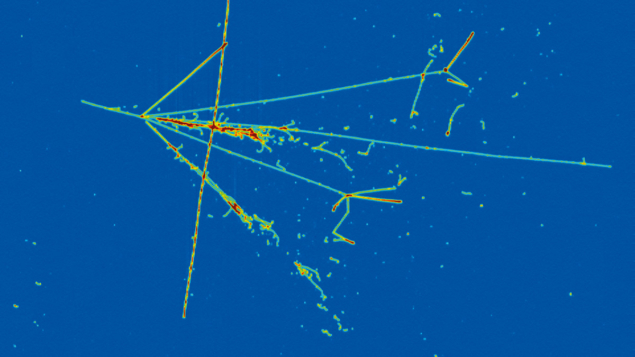
Particles and Fields research in the School of Physics tackles some of the most basic open questions about the Universe. Why is there far more matter than antimatter? Do the fundamental forces merge into one at high energies? Our faculty work on particle physics experiments and astroparticle observatories (with a focus on neutrinos), and they help design the next generation of experiments to answer these questions. We build statistical and machine learning tools used across particle physics, from the Large Hadron Collider to dark matter searches, and we test general relativity on cosmological scales. On the theory side, we use artificial intelligence to automate calculations, build phenomenological models and design experimental tests.
The group works closely with the Center for Relativistic Astrophysics, and it has strong links to the AI4Science Center and the Institute for Data Engineering and Science (IDEaS).
Faculty Members

Aishik Ghosh
Assistant Professor
Research Interests: Reasoning models for theoretical physics, high-dimensional statistical inference (eg. LHC, DUNE), design of future experiments

Afroditi Papadopoulou
Assistant Professor
Research Interests: Neutrino-nucleus interactions, precision simulation development, liquid argon time projection chambers (MicroBooNE, SBND, DUNE) charge-parity violation extraction

Ignacio Taboada
Professor
Research Interests: Neutrino Astrophysics with IceCube and P-ONE. AI methods in neutrino event reconstruction; AI methods on event selection for neutrino telescopes