For Georgia Tech physicists, this year’s Nobel Prize in Physics recognizes decades of work that helped establish neutrino astronomy as a new way to study the universe.
Francis Halzen, principal investigator of the NSF IceCube Neutrino Observatory and a professor at the University of Wisconsin-Madison, was honored by the Royal Swedish Academy of Sciences for his “decisive contributions to IceCube and the discovery of high-energy neutrinos of astrophysical origin.”
“Francis proposed building a neutrino telescope in Antarctic ice, and along with his collaborators, he proved that it is possible to detect neutrinos in this challenging environment,” says Ignacio Taboada, professor in the School of Physics and former spokesperson for the IceCube Collaboration. “IceCube was a technological tour de force, and its success is now recognized by this Nobel Prize. The award energizes the nascent field of neutrino astronomy.”
A. Nepomuk Otte, professor in the School of Physics, describes the impact of IceCube’s results as “breathtaking.”
“What we are witnessing is the opening of an entirely new window into the universe, providing us with a unique view of the most violent astrophysical objects and allowing us to study the elusive nature of neutrinos,” says Otte. “I am extremely excited about the prospects of pushing to even higher energies and deeper into the universe with the next generation of neutrino experiments planned at Georgia Tech and around the world.”
IceCube is a giant neutrino telescope located at the South Pole. Envisioned by Halzen in the late 1980s and completed in 2011, the instrument detects neutrinos, tiny high-energy particles that travel through the universe and rarely interact with matter. Scientists study neutrinos to better understand phenomena such as supermassive black holes and exploding stars.
Georgia Tech has been a member of the IceCube Collaboration since 2008. The collaboration includes more than 400 physicists from 58 institutions in 14 countries.
Georgia Tech researchers continue to shape neutrino astronomy by contributing to next-generation observatories. Taboada leads the design of the trigger system for the Pacific Ocean Neutrino Experiment (P-ONE) Observatory, and Otte is the principal investigator of the NSF-funded Trinity Neutrino Observatory in Utah.
Related Media
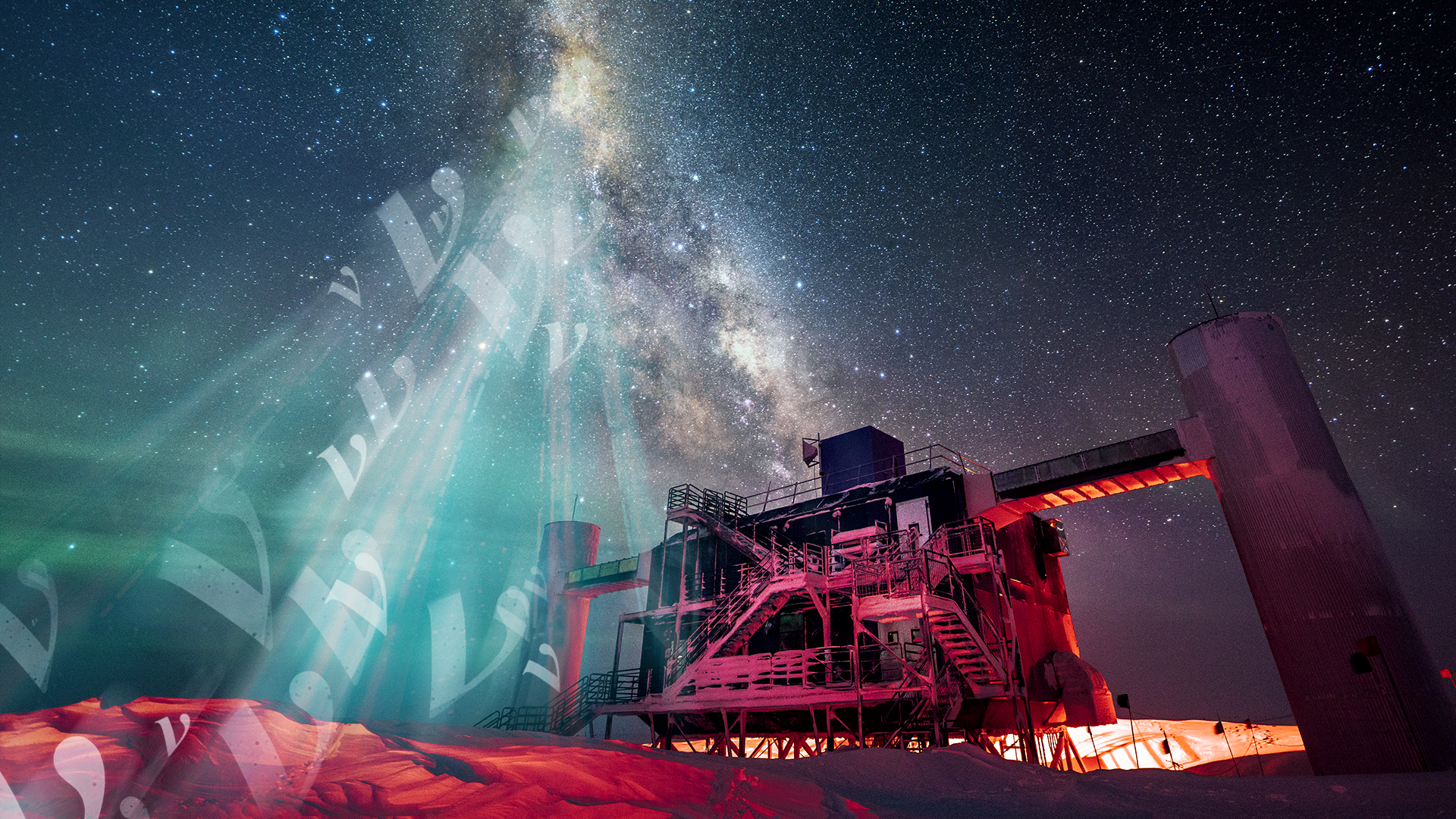
An artist's impression of neutrino emission from the Galactic plane, and IceCube Lab at the South Pole. (IceCube/NSF. Original photo by Martin Wolf)
For More Information Contact
Writer: Lindsay C. Vidal