In partial fulfillment of the requirements for the degree of
Doctor of Philosophy in Physics
School of Physics Thesis Dissertation Defense
Megan Arogeti
Dr. Laura Cadonati, School of Physics, Georgia Institute of Technology (Advisor)
Gravitational Wave Signal Reconstruction and Binary Neutron Star Postmerger Detection Using Stacking Methods
Virtual: https://teams.microsoft.com/meet/240561325650301?p=nvL8ezZRRym7CDoxSV
Thesis Committee:
Dr. David Ballantyne, School of Physics, Georgia Institute of Technology
Dr. Gongjie Li, School of Physics, Georgia Institute of Technology
Dr. John Wise, School of Physics, Georgia Institute of Technology
Dr. Edoardo Milotti, Physics Department, University of Trieste
Abstract:
September 14, 2015 marks the date of the first direct observation of a gravitational wave (GW). In the ten years that followed, the LIGO-Virgo-KAGRA (LVK) collaboration has observed hundreds of signals from merging compact binaries. Beyond measuring the extremely small distortion of spacetime caused by a passing gravitational wave, detecting and interpreting these signals requires advanced techniques. In this talk, I discuss two aspects of GW data analysis: validating the reliability of modeled waveforms and pushing our detection sensitivity beyond the limits permitted by individual events. I begin with a review of gravitational-wave astronomy and LVK observations. I then describe a method where we compare a source-agnostic reconstruction of a gravitational wave signal to a best-fitting waveform from a template-based analysis used to infer the source's properties. This test allows us to validate the efficacy of our waveform models and establish whether they are able to accurately describe the data. I report the results of my work applying this analysis to events from the fourth LVK observing run. In the second part of this talk, I first review the gravitational wave signals produced by a deformed binary neutron star (BNS) postmerger remnant. BNS postmerger signals carry information about the dense matter within neutron star cores, and could, therefore, be a direct probe into the properties of matter under some of the most extreme conditions. However, these signals are expected to be emitted at frequencies between 1-4 kHz, where detector sensitivity is reduced, making them extremely difficult to observe. For the next LVK observing run, the probability of a confident individual postmerger detection is well below one per year. With detector improvements, and especially third-generation detectors, we expect an increase in the number of BNS inspiral detections, some of which may contain postmerger emission that is too weak to be detected on its own. I therefore introduce a method for combining signals from multiple events in their time-frequency space to enhance postmerger detection probabilities. I then describe a framework to determine the presence of a BNS postmerger signal and to measure its characteristic frequency. Finally, I present the results from a proof-of-concept simulation study using simulated signals from three models of neutron star matter. I demonstrate that combining events has the power to increase the fraction of postmerger signals detected compared to analyzing events individually, showing promise for future observations.
Event Details
Date/Time:
-
Date:Thursday, November 5, 2026 - 12:00pm to 1:00pm
Location:
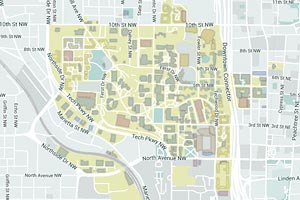
CRA Seminar Room (College of Computing) CCB 103