Robert Schulmann is an American historian who became known for his work on Albert Einstein. He studied history, receiving his doctorate in 1973 from the University of Chicago. In the early 1990s, he was an assistant professor of history at Boston University. Later he became director of the Einstein Papers Project. He is co-editor of the book "Einstein on Politics," based on Einstein's writings.
The lecture is part of Georgia Tech's 2019 Martin Luther King Jr Celebration, Jan. 10-Feb. 2.
Schulman will discuss the interplay the interplay of politics with Albert Einstein’s concerns for human rights and the trajectory of his professional career. How did a groundbreaking physicist come to be known as a keeper of the world's conscience?
The lecture will celebrate the 70th anniversary of the signing of the Declaration of Human Rights by the United Nations, proclaimed on Dec. 19, 1948.
Event Details
Date/Time:
As part of Georgia Tech’s year-long celebration of 2019 as the International Year of the Periodic Table of Chemical Elements (#IYPT2019GT), the College of Sciences and the College of Design’s School of Music have partnered to present a performance of original music inspired by the periodic table.
Avneesh Sarwate, a student in the Masters of Science in Music Technology program, has composed music for #IYPT2019GT to be played by the School of Music’s Laptop Orchestra. The orchestra comprises first-year music technology majors enrolled in MUSI 2015 Laptop Orchestra, a required music technology course. They will play the original composition and other repertory pieces using electronic devices, mostly laptop computers and mobile phones.
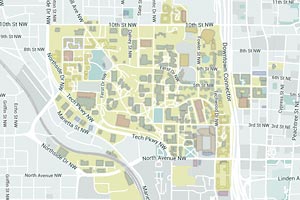
Closest public parking is Visitors Area 4, Ferst Street and Atlantic Drive, http://pts.gatech.edu/visitors#l3.
Event Details
Date/Time:
Abstract:
What kinds of shapes can you make by folding a sheet of paper? How strong can you make them, or how flexible? Although we've been folding paper for centuries, we're still discovering fascinating new answers to these questions. Origami-inspired structures can improve the energy-efficiency of massive buildings, deliver drugs deep within the body, power spacecraft and even stop bullets. As we learn to manipulate sheets as thin as a single atom, humanity approaches the ultimate origami challenge--folding structures as rich and varied as those nature achieves through folding proteins. We will discuss how all of these structures are achieved by mastering the geometrical structure hidden within every sheet of paper.
About the Speaker:
D. Zeb Rocklin joined the School of Physics at the Georgia Institute of Technology as an Assistant Professor in 2017. He received his undergraduate degree from the California Institute of Technology in 2008 and his PhD from the University of Illinois in 2013. He conducts theoretical research into the mechanics of a wide variety of soft and flexible systems. He has received fellowships from the Delta Institute of Physics, the Institute for Complex and Adaptive Matter, the DoD and Illinois.
Event Details
Date/Time:
Susan Lozier is Distinguished Professor of Ocean Sciences, Duke University, and
President-Elect of the American Geophysical Union. She is one of three finalists for the College of Sciences Dean search. She will present her vision of the college in this public seminar.
More information about Lozier is here.
Event Details
Date/Time:
Rodolfo Torres is University Distinguished Professor of Mathematics, University of Kansas. He is one of three finalists for the College of Sciences Dean search. He will present his vision of the college in this public seminar.
More information about Torres is here.
Event Details
Date/Time:
Kevin Pitts is Professor of Physics and Vice Provost for Undergraduate Education, University of Illinois. He is one of three finalists for the College of Sciences Dean search. He will present his vision of the college in this public seminar.
More information about Pitts is here.
Event Details
Date/Time:
Abstract: I knew from the time I was a very young child that I wanted to be an astronomer. The dream lasted until I got to college, where I learned to my dismay that I actually had no passion for doing what an astronomer does; what I really wanted is to know what an astronomer knows. This is the story of how it all worked out.
MICHAEL D. LEMONICK is the Opinion Editor at Scientific American. He has written more than 50 Time magazine cover stories on science, and has written for National Geographic, The New Yorker and other publications.
Event Details
Date/Time:
Your ghost host with the most, Professor Morte', brings you a special SCIENCE version of the Silver Scream Spookshow for the Atlanta Science Festival! Morte' and his gang of ghouls will entertain you before the film and your favorite genetically-modified rock band, Leucine Zipper and the Zinc Fingers, will play before the show!
The band features College of Sciences' Michael Evans, Jennifer Leavey, and Joe Mendelson.
Tickets available at the door. Doors open at 1 p.m.
Note: This is the matinee show. A second show will take place at 10 p.m.
More information
Event Details
Date/Time:
Abstract
At the outskirts of the solar system, beyond the orbit of Neptune, lies an expansive field of icy debris known as the Kuiper belt. The orbits of the individual asteroid-like bodies within the Kuiper belt trace out highly elongated elliptical paths, requiring hundreds to thousands of years to complete a single revolution around the sun.
Although the majority of the Kuiper belt’s dynamical structure can be understood within the framework of the known eight-planet solar system, bodies with orbital periods longer than about 4,000 years exhibit a peculiar orbital alignment that eludes explanation. What sculpts this alignment and how is it preserved?
In this talk, I will argue that the observed clustering of Kuiper belt orbits can be maintained by a distant, eccentric, Neptune-like planet, whose orbit lies in approximately the same plane as those of the distant Kuiper belt objects, but is anti-aligned with respect to those of the small bodies. In addition to accounting for the observed grouping of orbits, the existence of such a planet naturally explains other, seemingly unrelated dynamical features of the solar system.
About the Speaker
Forbes named professor Konstantin Batygin the “next physics rock star” in its 2015 list of “30 Under 30: Young Scientists Who Are Changing the World.” He received his bachelor’s degree in physics from University of California, Santa Cruz, in 2008, before pursuing graduate studies at California Institute of Technology.
Batygin has authored over 70 scientific publications,, His research has been featured on Nature, as well as the front cover of Scientific American.
Prior to joining the faculty at California Institute of Technology in 2014, Batygin was a visiting scientist at Observatoire de la Côte d'Azur, in Nice, France, and an ITC postdoctoral fellow at Harvard University. When not doing science, he moonlights as the lead singer in the rock band The Seventh Season.
Event Details
Date/Time:
The quantum laws governing atoms and other tiny objects seem to defy common sense, and information encoded in quantum systems has weird properties that baffle our feeble human minds. John Preskill will explain why he loves quantum entanglement, the elusive feature making quantum information fundamentally different from information in the macroscopic world.
By exploiting quantum entanglement, quantum computers should be able to solve otherwise intractable problems, with far-reaching applications to cryptology, materials, and fundamental physical science. Preskill is less weird than a quantum computer, and easier to understand.
About the Speaker
John Preskill is the Richard P. Feynman Professor of Theoretical Physics at California Institute of Technology and the director of the Institute for Quantum Information and Matter at Caltech.
Preskill received his Ph.D. in physics in 1980 from Harvard University. He joined the Caltech faculty in 1983.
Preskill began his career in particle physics and cosmology, but in the 1990s he got excited about the possibility of solving otherwise intractable computational problems by exploiting quantum physics. He is especially intrigued by the ways our deepening understanding of quantum information and quantum computing can be applied to other fundamental issues in physics, such as the quantum structure of space and time.
You can follow Preskill on Twitter @preskill.
The lecture is preceded by an exhibit about the life and work of David Ritz Finkelstein. The exhibit will be on display at Clough Commons Atrium on April 8-25, 2019.
About the Bold Ideas In Physics Lecture Series and Exhibit
The lecture series celebrates the life and work of David Ritz Finkelstein, the late School of Physics professor who was unafraid to challenge orthodoxy. The exhibit introduces Professor Finkelstein's life, his work on gravitational fields, space-time, quantum relativity, and quantum computations, as well as research by Georgia Tech faculty and students that continues some of his bold ideas. For more information, visit www.davidritzfinkelstein.com.
Event Details
Date/Time:
Pages