Eric Sembrat's Test Bonanza

Image: 

The normal modes and the density of states (DOS) of any material provide a basis for understanding its thermal and mechanical transport properties. In perfect crystals, normal modes take the form of planewaves, but they can be complex in disordered systems. I will show our recent experimental measurement of the normal modes, the DOS and dynamical structure factor (DSF) in disordered colloidal solids: disordered colloidal crystals composed of thermally sensitive micron‐sized hydrogel particles at several different particle volume fractions, φ. Particle positions are tracked over long times using optical microscopy and particle tracking algorithms in a single two dimensional (2D) [111] plane of a 3D face‐centered‐cubic single crystal. The dynamical fluctuations are spatially heterogeneous while the lattice itself is highly ordered. At all φ, the DOS exhibits an excess of low frequency modes, a so‐called boson peak (BP), and the DSF exhibits a cross‐over from propagating to n‐propagating behavior, a socalled Ioffe‐Regel (IR) crossover, at a frequency somewhat below the BP for both longitudinal and transverse modes. As we tune φ from 0.64 to 0.56, the Lindemann parameter grows from ~3% to ~8%, however, the shape of the DOS and DSF remain largely unchanged when rescaled by the Debye level. This invariance indicates that the effective degree of disorder remains essentially constant even in the vicinity of melting.

Event Details

Date/Time:

Neutron stars were discovered accidentally in 1967 although their existence was predicted 65 years earlier.  These exotic objects are the remnants from the deaths of massive stars, a death marked by one of the most spectacular pyrotechnic events in the cosmos, a supernovae explosion. Neutron stars have a solid crust overlying a sea of neutrons that can flow without friction (superfluidity). Their unique, yet not fully understood, internal structure, together with their immense gravitational field, makes them the perfect laboratory where the physics of the macro-cosmos meets microphysics phenomena. Explosive thermonuclear processes on neutron stars and their colossal magnetic field makes them observable across the electromagnetic spectrum, in radio, x, gamma rays and even in optical wavelengths. As members of binary systems, they are the best candidates for detection of gravitational waves. I will review our current understanding of neutron stars and the challenges in their theoretical and computational modeling.

Event Details

Date/Time:

The massive black holes found at the centers of most nearby galaxies, including our
own, are believed to be the ashes of the fuel that powered quasars early in the history of the universe. I will review the observational evidence for these objects and describe some of the exotic dynamical phenomena that originate in their vicinity, including hypervelocity stars, resonant relaxation, phase transitions, and lopsided stellar disks.

Event Details

Date/Time:

Superconducting circuitry can now be fabricated at the nanoscale by depositing suitable materials on to single molecules, such as DNA or carbon nanotubes. I shall discuss various themes that arise when superconductivity is explored in this new regime, including the thermal passage over and quantum tunneling through barriers by the superconducting condensate, as well as the hormetic impact that magnetism can have on nanosuperconductivity. I shall also describe circuits that realize nanoscale superconducting quantum interference devices, exploring their sensitivity to magnetic fields and spatial patterns of supercurrent. These features hint at possible uses of nanoscale superconducting circuitry, such as in mapping out the quantum phase of superconducting order and testing for superconducting correlations in novel materials and settings. If time permits, I shall also mention some emerging themes: the interplay between graphene and superconductivity, and what nanoprobes might be revealing about exotic superconductors.

Event Details

Date/Time:

X-ray science is undergoing one of its greatest revolutions to date with the construction of intense x-ray free electron lasers in Stanford, USA (LCLS), Hamburg, Germany (XFEL), and Harima Science Garden City, Japan (SCSS). These are vast, several-hundred-million dollar machines that will provide x-ray pulses that are many million times brighter than current sources. Similarly groundbreaking are the emerging attosecond light sources based on intense, pulsed lasers; they are relatively inexpensive laboratory-size instruments. These two emerging radiation sources will enable radically new research and have unnumbered potential applications in materials science, chemistry, biology, AMO, condensed-matter, and plasma physics. My work contributes to a theoretical understanding of atoms and molecules in gas phase which are exposed to x rays and optical lasers. Specifically, I discuss in my talk: * Electromagnetically induced transparency (EIT) for x rays and ultrafast x-ray pulse shaping * Attosecond Ramsey scheme for Auger decay * Double core holes in laser-aligned molecules

Event Details

Date/Time:

Prof. Flavio Fenton's nonlinear dynamics research lab featured in January 2015 issue of Dynamical Systems Magazine

Friday, February 6, 2015

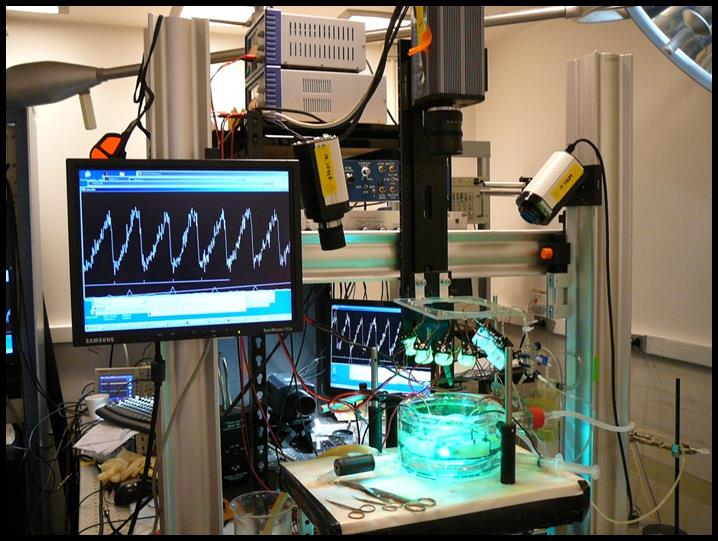
Entering the Georgia Tech laboratory of Flavio Fenton is a little like walking into a toy store for dynamicists: setups ranging from relatively simple candle and saltwater experiments to more complicated cardiac tissue preparations are visible, and everyone seems to be having fun. With two postdocs, a visiting professor from Brazil, three graduate students plus a fourth visiting from Mexico, and an assortment of undergraduates from multiple disciplines, the lab is buzzing with energy.

Click here to read more:
http://www.dynamicalsystems.org/ma/ma/display?item=555

Content Images: 
Summary: 

Prof. Flavio Fenton's nonlinear dynamics research lab featured in January 2015 issue of Dynamical Systems Magazine

Intro: 

Prof. Flavio Fenton's nonlinear dynamics research lab featured in January 2015 issue of Dynamical Systems Magazine

Alumni: 

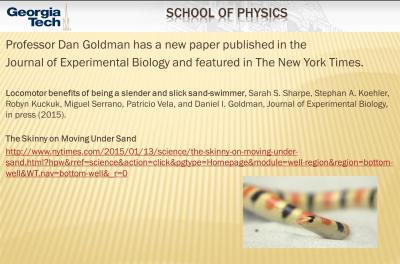
Prof. Goldman's newly published paper in the Journal of Experimental Biology

Tuesday, January 20, 2015
Summary: 

Prof. Goldman's newly published paper in the Journal of Experimental Biology

Intro: 

Prof. Goldman's newly published paper in the Journal of Experimental Biology

Alumni: 

Drs. Walt de Heer and Claire Berger receive the 2014 Reuters Most Cited Researcher award

Tuesday, January 20, 2015
Summary: 

Drs. Walt de Heer and Claire Berger receive the 2014 Reuters Most Cited Researcher award

Intro: 

Drs. Walt de Heer and Claire Berger receive the 2014 Reuters Most Cited Researcher award

Alumni: 

Albert Fert, who shared the 2007 Nobel Prize in Physics, delivers his talk "Spintronics: Electrons, Spins Computers and Telephones. 

Spintronics exploits the influence of the electron spin orientation on electronic transport. It is mainly known for the “giant magnetoresistance” (GMR) and the large increase of the hard disc capacity obtained with read heads based on the GMR, but it has also revealed many other interesting effects. 

Today spintronics is developing along many novel directions with promising prospects as well for short term applications as for the “beyond CMOS” perspective.

After an introduction on the fundamentals of spintronics, Fert will review some of the most interesting emerging directions of today: spin transfer and its applications to STT-RAMs or to microwave generation, spintronics with semiconductors, graphene and carbon nanotubes, Spin Hall Effects, neuromorphic devices etc.


Event Details

Date/Time:

Doug Osheroff, professor of physics at Stanford University and a Nobel Laureate in Physics, will present a lecture on "How Advances in Science Are Made."

ABSTRACT: 

How advances in science are made and how they may come to benefit mankind at large are complex issues. The discoveries that most influence the way we think about nature seldom can be anticipated, and frequently the applications for new technologies developed to probe a specific characteristic of nature are also seldom clear, even to the inventors of these technologies. One thing is clear: Seldom are such advances made by individuals alone. Rather, they result from the progress of the scientific community asking questions, developing new technologies to answer those  questions and sharing their results and their ideas with others. However,  there are indeed research strategies that can substantially increase the probability of one's making a discovery. Osheroff will illustrate some of these strategies in the context of a number of well-known discoveries, including the work he did as a graduate student, for which he shared the Nobel Prize for Physics in 1996.

Event Details

Date/Time:

Pages

Subscribe to RSS - Eric Sembrat's Test Bonanza