In partial fulfillment of the requirements for the degree of Doctor of Philosophy in Physics
School of Physics Thesis Dissertation Defense
Mateo Reynoso
Dr. Roman Grigoriev, School of Physics, Georgia Institute of Technology (Advisor)
Dynamical Mechanisms of Nonuniversality in 2D Turbulence in the Presence of Coherent Structures
Virtual: https://gatech.zoom.us/j/98641369716
Committee members:
Dr. Predrag Cvitanović, School of Physics, Georgia Institute of Technology
Dr. Michael Schatz, School of Physics, Georgia Institute of Technology
Dr. Alexander Blumenthal, School of Mathematics, Georgia Institute of Technology
Dr. Rafael de La Llave, School of Mathematics, Georgia Institute of Technology
Abstract:
Turbulence is one of the most important problems in physics and applied mathematics, with applications ranging from astrophysics and engineering to plumbing and more. It is fundamentally a multiscale phenomenon, characterized by cascades that dynamically transfer energy and other invariants across a wide range of length scales. While these interactions are often described through a statistical framework, a more holistic understanding requires accounting for the spatial structure of the flow. Aspects such as the coherence of large-scale structures cannot be captured by statistical assumptions alone; therefore, a more general theory for scaling in turbulence must explicitly account for the dynamical role of coherent structures.
This dissertation examines how coherent structures shape scale generation and nonuniversality in two-dimensional turbulence, with an emphasis on both the direct enstrophy cascade in steady turbulence and the inverse energy transferr in freely decaying turbulence. Although classical Kraichnan–Leith–Batchelor theory predicts universal scaling under assumptions of homogeneity, isotropy, and locality, the results presented here show that the observed scaling is instead governed by the geometry and interactions of coherent structures, often organized as large-scale flows. By combining direct numerical simulations, reduced-order modeling, and statistical closure arguments, this work demonstrates that a predictive theory of turbulence scaling must move beyond statistical assumptions and account for the transport and lifecycle of coherent structures.
Event Details
Date/Time:
-
Date:Tuesday, April 21, 2026 - 1:00pm to 2:00pm
Location:
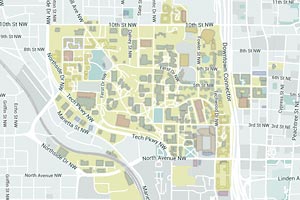
Howey Physics Building N110